


 Dead battery
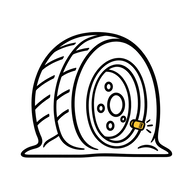 Flat tire
 How to jump start a car
 What to do after a breakdown on the highway
I-89, exit 14 and the Beltline
I-89 enters the Burlington area from the southeast after following the Winooski River and US-2 through the mountains. For about 40 miles past Montpelier, Camel's Hump rises on the south side and Mount Mansfield on the north, both over 4,000 feet. At Richmond the road drops into the Champlain Valley and bends north toward the city.
I-189 begins at exit 13 in South Burlington. Exit 14, a full cloverleaf serving downtown, the University of Vermont and Dorset Street via US-2, is described as the busiest freeway interchange in Vermont. Cloverleafs have short weaving ramps, so a car with a flat tire or a stall there needs a quick exit. A guide to flat tire help on the road explains what a crew does, and you can read using a spare tire safely first.
US-2 and US-7 cross the city. VT-127, the Burlington Beltline, marks the western edge of the New North End. Stop-and-go driving on those roads causes small collisions, and if yours is one, the minor accident checklist covers swapping details.
Lake snow and an 86 inch winter
Burlington averages about 86 inches of snow a year, more than most of the state's lowlands. The January average temperature is 21 degrees, and the lake sometimes produces squalls that drop up to 13 inches in 12 hours. The record single storm was 33.1 inches on January 2 and 3, 2010.
Those storms strand cars at the curb. Dig around the tires first, then read how to get unstuck from snow and call a crew with a winch if the car is in a ditch. A battery is likely to fail on the next morning below zero. The record low in town is 30 below, and an overnight deep-freeze no-start leads the list of calls. Winter tires are the other half of the plan. A tire shop can mount them, and our guide to checking tire pressure matters because cold drops it.
A hospital and university city
UVM Medical Center and the University of Vermont are the biggest employers in the city, with more than 8,200 and 4,125 workers. Champlain College is in town as well, and Saint Michael's College is in Colchester. A car that sits all week in a hospital or campus lot may not start on Monday, and a dead battery is the likely reason.
Frost heaves are hard on alignment, so if a car pulls hard to one side, read about why it drifts.
North and south from the city
Patrick Leahy Burlington International Airport is in South Burlington. Williston, to the east on I-89, has become the region's big-box shopping center. Colchester, with exits 16 and 17, lies to the north. Burlington is about 45 miles south of the Canadian border and about 95 miles from Montreal, so many cars here make trips across the line. Long drives call for a scheduled oil change, found under oil change service, and a check of the oil level.
When a long haul ends with a car that will not run, a far-off tow is the service to price.
If your car is towed
Vermont's abandoned vehicle rules apply. If a tow business moved your car as abandoned, it has 90 days to file with the DMV, and the DMV mails the owner a certified notice. Do not wait for it. Call the Burlington police non-emergency line, since a private property owner who has a car removed has to notify local police at once, and have the plate, make and color ready. Once you locate it, take your registration and ID and expect to pay lawful towing and storage fees.
Another Vermont guide
South on US-7, Rutland is the state's third city and the gateway to the Killington area.
Updated November 25, 2026




