


 How to get unstuck from mud or snow
 Car stuck in park
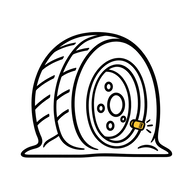 Flat tire
Read the situation first
Before you touch the gas again, get out, if it is safe, and look at the car from every side. Ask four questions.
- How deep are the tires? If the frame or the underbody rests on the ground, the car is high-centered and tire traction will not help.
- Which wheels spin? A single spinning wheel with the others dead is a drivetrain trait, not a lack of power.
- What is the slope? A car that could roll when freed is dangerous to dig under or beside.
- Is anyone in danger from traffic, water, ice or a drop? If so, that comes first.
Your answers choose the fix. Our guide to getting unstuck from mud and snow has the standard low-risk techniques. This page helps you decide when to stop trying them.
Why one wheel spins and the car stays put
Most cars use an open differential, which sends equal torque to both driven wheels. The torque through an open differential is always equal at both wheels, so a wheel on ice or mud can only spin and absorbs most of the engine's power while the wheel with grip gets too little to move the car. Brake-based traction control tries to solve this by braking the slipping wheel, which sends more drive to the other side, though the same article notes it does not send extra torque on its own.
This is why a gentle, steady throttle usually works better than a big push, and why turning traction control off can sometimes help in deep snow where some wheelspin is needed to clear the tread. Check the manual before you change that.
What to try first, and when to stop
Light slipping on snow, wet grass or loose gravel
- Straighten the front wheels. Turned wheels plow rather than roll.
- Clear snow or mud from in front of and behind each driven tire.
- Use the gentlest throttle you can, and try second gear in a manual or a snow mode in an automatic.
- Rock the car by shifting between drive and reverse with a light touch, only as long as the car is moving a little more each time.
- Put a floor mat, sand or traction boards under the drive tires. Do not use sharp or flammable objects.
When to stop
Stop rocking if the car does not gain ground after a handful of tries, if the engine or transmission smells hot, or if the tires have dug in to the rim. Slow wheel spinning also overheats the transmission, and a burned clutch or gearbox costs far more than a tow. See transmission repair for what damage looks like.
Do not crawl beneath a car that sits on a jack, and keep clear of the path of any car that could roll.
Stuck in sand or loose dirt
Soft sand rewards lower tire pressure, since a softer tire has a bigger contact patch. Letting some air out is a standard trick, but you must re-inflate as soon as you reach hard ground, and you need a way to do it. A tire driven low at speed can come off the rim. Our guide to checking tire pressure shows how to measure the change and what to inflate back to. If you have no gauge, leave the pressures alone.
Digging a ramp in front of each tire at a shallow angle often helps more than air. Do not dig under a car unless it is fully supported on solid ground. Tire repair shops can check for damage if you were driving flat.
High-centered, curbed or in a ditch
A car that sits on its frame or on a rock has lost the weight on its tires, and no throttle will fix that. Do not try to drive over it. A ditch at a steep angle, or a car with a wheel off the ground, calls for pulling it out along the way it came in. This is a job for a winch-out service, which uses a cable and anchor to pull the car without driving it. If the car has gone down an embankment or into deeper water, a flatbed often follows to load it. Heavier vehicles such as vans or box trucks may need medium-duty equipment, and large rigs need heavy-duty towing.
Do not attach a chain or strap to anything but a rated recovery point. A hook on a bumper cover or a suspension arm can fail and fling metal. A snapped strap can injure someone standing nearby.
Winter safety with the engine running
If you must wait in a stuck car, keep the exhaust pipe clear. The CDC warns that a small exhaust leak can let carbon monoxide build up inside a car, and that people can die before they have symptoms when they are asleep (CDC, About carbon monoxide). A tailpipe packed with snow can send exhaust back toward the car, so treat it as the same danger. Dig the pipe clear, crack a window and run the engine only in short spells. Headache, dizziness, weakness and nausea are the warning signs.
A car that will not move in park or gear
If the wheels are free and the car will not shift out of park, that is not a traction problem. See car stuck in park. If the transmission will not move the car even on flat, dry road, the cause is mechanical and a tow is the right move.
Updated November 25, 2026



