
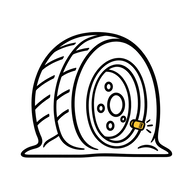

 How to change a flat tire
Why the warning light matters
Cars sold new in the United States since the late 2000s carry a tire pressure monitoring system. The federal rule behind it requires a warning when pressure in one to four tires is 25 percent or more below the manufacturer's recommended cold pressure. That is a big loss. A tire can be quite soft and still not trigger the light, so a gauge is still worth using monthly.
Low pressure wears tires faster, hurts handling, and can lead to a blowout. It also adds to fuel use, a point covered in poor fuel economy.
What you need
- A tire pressure gauge. A digital one is easy to read, but a pencil gauge works.
- An air source, such as a gas station compressor or a small 12-volt inflator.
- Your owner's manual, or the placard the carmaker puts on the car, often on the driver door frame.
- Valve caps, which you should keep to stop dirt getting in.
You do not need to pump anything into a tire that is already at the right number.
Find the right number
Use the pressure on the vehicle's placard or in the manual, not the maximum pressure printed on the tire's sidewall. The sidewall number is the most the tire can hold. The placard number is what the carmaker chose for your car's weight, and it may differ front and rear. Some cars list a higher pressure for a heavy load or sustained highway driving.
Steps
- Check when the tires are cold. That means the car has sat for at least a few hours or has been driven only a short distance. Driving heats the air inside and raises the reading, so a hot check will show too high a number.
- Unscrew the valve cap and press the gauge straight onto the stem until the hissing stops.
- Read and note the number. Press again if you heard a lot of air escape.
- Add air in short bursts if low. Recheck after each burst.
- If too high, press the center pin of the valve briefly to let air out and recheck.
- Replace the cap. Do all four tires and look at the spare too.
Temperature changes matter. In cold weather the pressure falls, which is why the light often shows up on the first cold morning of the season. Check every tire then.
What a TPMS light can mean
A steady light usually means at least one tire is low. Find the soft tire, inflate to the placard number, and the light should go out after you drive a short distance. Some cars need a reset button or a procedure in the manual.
Some cars signal a fault in the monitoring system differently from low air, for example by blinking before staying lit. Your manual explains your car's signals. A faulty sensor cannot warn you about a soft tire, so keep checking by hand. You can get this fixed at a tire shop.
Do not confuse this with an engine problem. The amber engine symbol is covered in the check engine light page.
When air is not the problem
Get help if:
- A tire is visibly flat, bulging or has a nail or gash in the sidewall. Do not drive on it. Read how to change a flat.
- A tire loses air again within hours of being filled. That indicates a leak, a bad valve or a damaged rim.
- The car pulls hard to one side or shakes. See car pulling to one side and steering wheel shaking.
- You cannot reach an air source. A roadside tire service can help.
If your spare is a space-saver, its pressure and limits are in spare tire safety.
Updated November 25, 2026




