


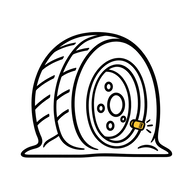
 How to check tire pressure and TPMS warnings
Start with when it happens
Take a short, safe drive on a straight, quiet road and note the pattern.
- Shakes between roughly 50 and 70 mph, then smooths out. Classic wheel balance or a tire problem. Front tires affect the steering wheel most, while rear ones are felt in the seat.
- Shakes only when you brake. Rotor or caliper trouble. A thickness variation of about 0.17 mm in a rotor can be felt as pedal pulsation.
- Shakes at a stop or idle, and the whole car vibrates. Look at the engine, not the wheels. See a rough idle or misfire.
- Shakes while accelerating. Often a worn axle joint or an engine mount.
- Shakes after hitting a pothole or curb. A bent wheel, a bent suspension part or a shifted belt inside a tire.
- Wobble and clunking at low speed. A loose tie rod end or wheel bearing, which is a safety matter.
Causes, from most to least common
1. Tires out of balance. A wheel with a small heavy spot shakes at certain speeds. Weights can fall off, or tires wear unevenly. A tire shop can balance the wheels on a machine, and this is among the cheapest fixes.
2. Low pressure, uneven wear or a damaged tire. A bulge, a separated belt or a flat spot causes a shake. Check pressure first with the steps in our guide to measuring tire pressure. Look for a bubble on the sidewall, which means the tire should be replaced. Details on replacement are on the tire repair and replacement page.
3. Warped or uneven brake rotors. If the shake appears only when braking, the cause is likely in the front brakes. Rotors that have uneven pad material stuck to them or have worn unevenly make the wheel shudder. In its September 2026 update, RepairPal listed rotor replacement at $574 to $698, leaving out taxes and local pricing. A shop can often machine rotors if they are thick enough, so ask. For more about brake problems, see brake repair.
4. Alignment out of spec. Poor alignment tends to pull the car or wear tires unevenly, and the uneven wear then causes the shake. The Car Care Council recommends annual alignment checks to help tires last longer. See wheel alignment and our page on a car that pulls to one side.
5. Worn steering and suspension parts. Tie rod ends, ball joints, control arm bushings and wheel bearings all loosen with age. A looseness shake feels vague, and often comes with a clunk or wander. Read clunking over bumps if you hear a knock. These repairs fall under suspension and steering repair.
6. Bent wheel or loose lug nuts. If the shake started after a tire change, check that lug nuts were tightened. Loose lug nuts are dangerous and can let a wheel come off.
7. Engine or driveline problems. Misfires, worn engine mounts and a failing axle shaft or driveshaft can shake the whole car, not just the wheel.
What to check right now
- Walk around the car. Look at each tire for a bulge, uneven wear or a missing wheel weight, which looks like a clean patch on the rim.
- Check tire pressure when cold, and set it to the number on the door jamb.
- Look at the lug nuts. If any look loose or any wheel studs are missing, do not drive.
- Note which speed the shake begins and ends. Tell the shop.
- Try the brake gently at a low speed on an empty road. Does the shake come only then?
Stop here if the shake is violent, if the wheel moves a lot when you turn it at a stop, or if a clunk, grinding or burning smell goes with it. Do not tighten or adjust steering and suspension parts yourself, and do not go under the car on a jack.
Power steering and the shake
Newer cars use electric power steering, and older ones use a hydraulic pump. In both designs the steering wheel stays mechanically linked to the wheels, so you can still steer if assist fails, though the wheel gets much heavier. A shake is rarely a power steering fault, but a groan or heavy feel along with a shake means more than one thing is wrong.
Getting it fixed
Start with the cheapest and most likely: tire balance and pressure, then alignment, then brakes and suspension. A good shop will inspect the tires, spin the wheels on a balancer, then road test. If a shake began right after other work, return to that shop. Balancing and alignment prices vary by shop, so ask for quotes.
If the shake is severe, a light-duty tow is better than driving a car with a damaged wheel or loose steering.
Updated November 25, 2026




