
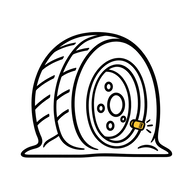

 How to change a flat tire
Blowout, puncture or slow leak
Each kind of flat has its own story.
- Sudden blowout. A loud bang, a hard pull toward the failed tire, and shredded rubber. Often an old, overheated or badly underinflated tire. Hold the wheel firmly, ease off the gas, and let the car slow on its own before braking gently.
- Puncture. A nail or screw in the tread. The tire may hiss, or stay up for hours. You may find it only because the pressure light came on.
- Slow leak. The tire loses a few pounds a week. Causes include a small puncture, a corroded wheel rim where the tire seals, a loose valve core, or a cracked valve stem.
- Cold morning flat. Air contracts in cold weather, so a tire can look flat on the first freezing day and be fine once warmed. Check the real pressure before assuming damage.
The warning light and what it measures
Light vehicles sold in the US after September 1, 2007 must have a tire pressure monitoring system. The driver must be warned when pressure falls 25 percent or more below the placard value in one to four tires. That is a big drop. A tire at 35 psi would not trigger it until it sat near 26 psi, and by then it is low enough to heat up and wear badly. Do not wait for the light. Our guide to tire pressure and warning lights shows how to measure with a gauge, and where to find your car's correct number on the door jamb sticker.
Low pressure also costs money. fueleconomy.gov says under-inflated tires lower gas mileage by about 0.2 percent for every 1 psi drop in the average pressure of all tires.
What to do at the roadside
- Signal early, ease off the gas, and steer to the shoulder or a parking lot. A flat on a freeway needs more care, so read about waiting safely after a highway breakdown.
- Flashers on, parking brake set, transmission in Park.
- Look at the tire. If it is merely low and you are near an air pump, you may be able to reach it slowly.
- If you have a spare, a jack and a lug wrench, follow our steps to change the tire. Most cars keep all three under the trunk floor, and our guide to finding the spare and jack helps when they are somewhere else. Keep your body out from under the car at all times while it sits on a jack.
- If the spare is a compact one, read the rules for using a temporary spare first. They are limited in speed and distance.
- If the car carries a sealant kit instead of a spare, the sealant and inflator steps can get a small tread puncture to a shop. If you have no spare or kit, or the wheel is damaged, get a flat tire change or a tow.
Stop here and call for help if you are on a narrow shoulder with fast traffic, on a slope or soft ground, if the wheel nuts will not budge, or if the car has no jack point you are sure of. A tow is better than leaning into traffic.
Can it be repaired?
A shop can sometimes plug and patch a small puncture in the tread, from inside the tire. Shops generally refuse to repair damage to the sidewall or shoulder, large holes, or a tire that was driven flat, because the inside structure may have been damaged. If the tire has been driven on while flat, expect to buy a new one. If you replace one tire, ask the shop whether it should match the other tire on that axle.
For tire repair and replacement, see tire repair and replacement. No verified price range for patching or replacing a tire was available to us, so ask for a written quote for your size, including mounting and balancing.
After the flat is fixed
- Check the others. If one tire went flat from a blown-out sidewall or old age, the rest may be close behind. Look for cracks, bulges and uneven wear.
- Check alignment if wear is uneven. One edge worn down points to a wheel alignment problem. If the car also drifts, see pulling to one side.
- Reset the light. Some cars need a drive or a manual reset after the pressure is corrected.
- Remember the spare. Refill it. A spare that sits for years is often low when you need it.
The Car Care Council advises keeping tires properly inflated and having alignment checked annually, because both extend tire life.
When a tow is the right call
Choose a tow if the wheel is bent, if the tire has come off the rim, if there is no safe place to work or if you cannot change a tire. A flatbed tow avoids rolling the damaged wheel, and the shop can mount a new tire once the car arrives.
Updated November 25, 2026




