


 Flat tire change
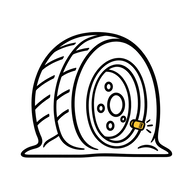 Flat tire
Will the kit seal this puncture?
The sealant is made for small holes in the tread, the part of the tire that touches the road. Kia, for one, puts the useful limit near 4 millimeters, about 0.16 inch, which covers most nails and screws.
- Good candidates: a nail, screw or stone hole in the tread, with the tire still seated on the wheel.
- Poor candidates: a cut or bulge in the sidewall, a gash, a tire peeled away from the rim or chewed up by driving flat, and a bent wheel.
- Two flats: one bottle holds enough for a single tire.
- Extreme cold: some kits are not meant for use below about minus 22 degrees F.
If a nail or screw is still in the tread, leave it there. Pulling it out lets more air escape.
What is in the box
Expect a compressor with a gauge, a cord for the 12-volt outlet, a hose for the tire valve, and a bottle of sealant that screws onto the compressor or has its own hose. Many bottles carry a speed sticker. Check the use-by date on the bottle today. Some carmakers warn that expired sealant raises the risk of tire failure, and a used bottle has to be replaced before the next trip. Gloves help, because the sealant is messy and can stain the wheel.
Sealing and filling the tire, step by step
- Park somewhere flat and well clear of traffic, turn on the hazard lights and set the parking brake. Kneeling beside a live lane is the biggest risk in this job.
- Find the valve stem on the flat tire and unscrew its cap.
- Shake the sealant bottle and connect it to the compressor and hose the way the kit's label shows.
- Screw the hose firmly onto the valve. A loose fitting lets sealant flow back up the hose and clog it.
- With the compressor switched off, plug it into the 12-volt outlet, then start the engine so the compressor does not drain the battery. Do this outdoors, never in a closed garage.
- Switch the compressor on. It pushes the sealant in first, then air. One Kia kit, for example, takes about 5 to 7 minutes. Stand to one side of the tire, and do not run the compressor for more than about 10 minutes at a stretch.
- Switch off, unplug and disconnect the hose. Stick the speed label on the steering wheel.
Drive right away, then read the gauge
The sealant only closes the hole once the spinning tire spreads it across the inside of the tread. Carmakers such as Kia tell you to set off at once and drive about 4 to 6 miles, roughly 10 minutes, staying under 50 mph and, where it is safe, above about 12 mph. Then pull over somewhere safe, reconnect the compressor's hose and read the pressure.
- At or near the door jamb figure: the seal is holding. Top up if needed and head for a tire shop.
- Low, but above the minimum in your manual: add air, drive another short stretch, and recheck.
- Below that minimum: stop driving. Kia manuals, for example, set the floor between 26 and 29 psi depending on the model.
The speed and distance limits on the label
A sealed tire can lose air at any time. The limit on the bottle, the sticker and the owner's manual is the rule for your car. Many Kia and Hyundai kits, for instance, allow up to 50 mph and up to about 120 miles. Treat that as a ceiling for reaching a shop, not a plan for finishing the trip. Steer and brake gently, and if a new vibration or thumping starts, slow down and pull off as soon as it is safe.
Tell the tire shop the sealant is inside
Mention it the moment you hand over the keys. The sealant coats the inside of the tire, the wheel and the pressure sensor that sits on the valve on many newer cars. Kit suppliers such as Kia tell the repairer to clean sealant off the sensor and wheel quickly, since dried sealant can foul the sensor. The shop then decides whether the tire can be patched or must be replaced, and some carmakers simply say to replace a sealed tire. If the pressure warning stays on afterward, our guide to gauges and TPMS warnings explains it.
Run-flat tires work differently
Cars on run-flat tires usually have no spare, because stiffened sidewalls hold the car up after the air is gone. The pressure warning on the dash may be the only sign of trouble, so heed it. Many run-flats are rated for about 50 miles at around 50 mph, though the figure ranges from roughly 25 to 200 miles by tire and vehicle. Once a run-flat has been driven without air, repairing it may be unsafe or impossible.
Stop and call for help when
- The hole is in the sidewall or longer than a nail, or the tire has slipped off the rim.
- The compressor runs its full time and the gauge will not climb toward the label pressure.
- The pressure falls below the manual's minimum after the short drive, or keeps dropping after a second try.
- The kit is missing, used or expired, or the car has two flats.
- The only place to work is a narrow shoulder or the inside lane.
A tire crew that comes to you can fit a spare if you have one, and a flatbed truck carries the car without rolling on the damaged tire. Our page on why tires lose air covers slow leaks, and beside fast traffic, getting safe on the highway comes before any repair.
Updated November 25, 2026




