


 Car stuck in mud, snow or a ditch
 Check engine light on
 How to get unstuck from mud or snow
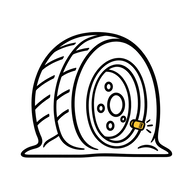 How to check tire pressure and TPMS warnings
How towing works under Vermont law
Vermont's DMV publishes its towing rules around one idea, the abandoned motor vehicle in 23 V.S.A. section 2151. Under that statute a car left on public or private property, or beside a highway, past 48 hours without the owner's consent is abandoned if it still has a valid plate. A car with no valid plate or a removed vehicle identification number can count at once, and so can any car a law enforcement officer asks a tow business to remove.
Who may order the tow depends on where the car sits. Only a law enforcement officer may remove an abandoned car from public property, and only after personally seeing it abandoned. On private property, an officer may act on the owner's complaint, and the owner or person in control of the property may also hire a tow business. If the owner does, the owner must notify local police at once with the plate number, VIN, make, model and color.
The page does not set a dollar cap. It says a towing service may charge a reasonable fee to tow an abandoned car from private property, which the property owner pays, and that no storage fee may run before the date the tow business sends its certification form to the DMV. If you plan to hire a truck yourself, a light tow is priced by agreement, so ask for the total first. Our guide to private lot towing explains the typical tripwires.
Getting a towed car back
The tow business has 90 days after removing the car to file the abandoned vehicle certification, form VN-012, with the DMV. When the plate or VIN identifies the owner, the DMV sends a notice to the last registered owner and any lienholder by certified mail within three business days of receiving the form. If that receipt is not returned within seven business days, a second notice goes by first-class mail. After that second mailing, the owner or lienholder has 21 days to reclaim the car by showing satisfactory evidence of ownership and paying or arranging to pay the towing and storage charges.
If nobody reclaims the car in that window, the DMV issues a Certificate of Abandoned Motor Vehicle, with a title or salvage title, and the car can be disposed of. So when your car vanishes, call local police first, because the removing party has to tell them. Do not wait for the mail.
The Move Over rule
Vermont's rule is in 23 V.S.A. section 1050. When you approach a stationary police, ambulance, fire or rescue vehicle, or a towing or repair vehicle showing amber lights, you must proceed with caution. On a road with more than one lane, you should change to a lane farther from the stopped vehicle if conditions allow. If you must stay in the adjacent lane, slow to a reasonable and safe speed for the conditions and the posted limit. A separate subsection applies the same caution to work zones.
That is the part that protects the person changing your tire. If you are the one stopped, follow the highway breakdown steps and how to change a flat, and stop at the first safe pull-off rather than limping a long way on a damaged tire.
Road reports
New England 511 at newengland511.org carries Vermont. It has a traffic map, an events list, cameras, message signs, travel time lists and a ferries page, plus an account option for saved routes and alerts. Check it before a trip over a mountain road, because mountain roads here have few detours.
Inspections and emissions
Vermont has required safety inspections since 1935 and emissions inspections since 1997. About 1,600 licensed stations and 5,000 certified inspection mechanics, all privately run, do the work under DMV licenses. The DMV says there is no grace period. Cars built from 1996 are checked through the OBD II port, and one fails if the connector is missing, if the malfunction light does not come on at key on, or if the light stays lit while the engine runs.
That ties inspection straight to repairs. A lit light means a code is stored, so start with why the check engine light comes on, or read the codes yourself using an OBD-II reader. A shop that handles engine light diagnosis can sort out the cause, and rust-related failures show up in exhaust repair and steering and suspension work.
Check the warranty before you pay. Vermont law requires the whole emissions system to be warranted for at least 3 years or 50,000 miles, major components for 7 years or 70,000 miles, and the catalytic converter for 8 years or 80,000. Drivers who cannot afford an emissions repair may qualify for the state's Automotive Emissions Repair Assistance Program. See also replacing a catalytic converter.
Snow, salt and mud
The Green Mountains run down the middle of the state. Mount Mansfield reaches 4,400 feet, and annual snowfall runs from 60 to 100 inches depending on elevation. The record low is minus 50 degrees. Cold mornings are hard on batteries, and a no-start on a frozen morning is the signature call, usually fixed with a jump and a battery test.
Spring brings mud season, when dirt roads soften and sag. A car stuck to the axles may need a winch, and a driver who tries to rock it out for twenty minutes can burn a clutch. Start with getting unstuck from mud or snow and stop when the wheels dig deeper.
Salt and rough pavement hit the underside. Rust eats brake lines, exhaust hangers and control arms, and frost heaves cause clunks over bumps.
The two Vermont metro guides
Vermont has only 644,000 or so residents, about 70 people per square mile, so we describe the two places where most calls cluster. Burlington is the lakefront hub at the north end of I-89, with the interstate running 130 miles from White River Junction to the border. Rutland sits in the middle of the state where US-4 and US-7 cross, with Killington close.
Updated November 25, 2026



