


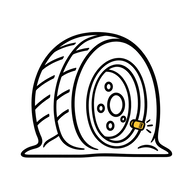
 Flat tire
 Car won't start in the cold
 Brake repair
The big interchanges
Milwaukee sits on the west shore of Lake Michigan where the Menomonee, Kinnickinnic and Milwaukee rivers meet. Interstates 43 and 94 cross downtown at the Marquette Interchange, which was rebuilt between October 2004 and September 2008. West of downtown the Zoo Interchange links I-94, I-894, I-41, US 41 and US 45. It was designed for about 115,000 vehicles a day and carried 345,900 a day in 2008, roughly three times that. Rebuilding began in 2014, with the core finished in 2018 and the north leg in 2022.
That history matters for a stalled car. Even after the rebuild, ramps are tight and traffic is dense, and a car that stops on a ramp can be struck from behind. If your car slows, steer toward the right side early, switch on hazards, and read the highway breakdown steps before you need them.
I-43, I-894 and the south side
On the southwest side, I-894 bypasses the center of the city. It shares a roadway with I-43 and I-94 between the Hale Interchange and the Marquette Interchange, and the Mitchell Interchange is where I-894 ends and I-43 follows I-94 north. The Airport Freeway carried 107,000 to 134,000 vehicles per day as of 2007, and the highway has six lanes through most of the metro area and eight near the Marquette.
Because lanes narrow where roads merge, a flat tire there is more dangerous than the same flat on a quiet road. A tire change is usually safer done by a crew with truck-mounted lights than on a freeway edge. If you must change one, only do it on a wide, flat shoulder, and use the steps in changing a flat tire.
The Hoan Bridge and the harbor
I-794 crosses the harbor on the Hoan Bridge. A bridge over open water is exposed to the lake wind, and a stalled car on a span has very little room to move. In winter, keep a warm coat and gloves in the car for the wait. A flatbed tow is the better choice for low or all-wheel-drive cars that should not be dragged.
Lake weather and what it does to cars
Milwaukee's January averages about 24 degrees and July about 73, and the record low is minus 26. Lake breezes are most common from March through July and can drop temperatures sharply inland. The lake keeps the shore from the worst cold, while suburbs inland get colder nights. When the mercury falls, a battery that has given up follows, and a jump start is the quick answer.
Winter salt on freeways attacks the underside of cars, especially brake lines and exhaust. After a long, salty winter, a rattling tailpipe can mean a rusted exhaust system. Spring then brings potholes, and a bent wheel or a car that pulls left after one is a reason to look at alignment.
Festival season and downtown crowds
Milwaukee calls itself the City of Festivals. Summerfest, described as one of the world's largest music festivals, is joined by German Fest, Oktoberfest, Polish Fest, Festa Italiana and Irishfest. Street closures and packed lots mean cars get blocked in and parked cars are removed from posted lots. If a car is removed from a private lot or garage, the procedure is on the tow-away page, and the state page explains what the company has to tell police. Photograph your parking spot and nearby signs, then ask the city or the property manager where the car went.
If the car was moved from a freeway lane after a crash, a county may have ordered it. The state page explains the county removal rule, so ask which agency holds the car before you visit any lot.
Heading out of town
I-43 runs north to Sheboygan, Manitowoc and Green Bay, and the Green Bay page covers the end of that route. I-94 west from the Zoo Interchange leads to Madison, about 77 miles away. Both are long summer drives, so check levels first with the guide to checking coolant.
Updated November 25, 2026




