


 Car stuck in mud, snow or a ditch
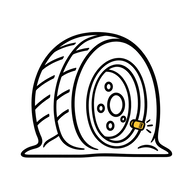 Flat tire
 How to change a flat tire
 Flatbed towing
How impound towing is regulated
Washington's towing law is chapter 46.55 of the Revised Code of Washington. Registered tow truck operators are defined there as anyone who impounds, transports or stores unauthorized vehicles. An operator must file its fee schedule with the state, and under RCW 46.55.063 no fee may exceed what was filed. Revisions must be filed at least ten days before taking effect. Towing is billed hourly, with time after the first hour rounded to the nearest quarter hour. Storage is billed in 24 hour blocks rounded to the nearest half day. Up to 60 minutes of unloading and paperwork may be charged as part of the tow, and the invoice must itemize each charge. The statute does not publish a dollar cap, so the filed schedule is the number to ask for.
Private property impounds need a written contract that states the hours when impounds are authorized, who can authorize them and the charge per truck class. Operators may not take payment from a property controller for towing a car under RCW 46.55.035, which makes a kickback arrangement a gross misdemeanor.
Getting a car back
Under RCW 46.55.120 the registered owner, the legal owner, someone the registered owner authorizes in writing, or the insurer can redeem the car. Bring proof of who you are and of your right to the car. The operator must accept a commercially reasonable tender such as cash, a major credit card or a personal check with two valid IDs. You can redeem any time before the auction by paying the towing and storage fees, and a vehicle that is not redeemed within 15 days of the custody and sale notice goes to auction.
If you think the tow was wrong or the bill too high, you have a right to a hearing in district or municipal court depending on who ordered the impound. The request must reach the court within 10 days of the notice and more than five days before the auction. Miss the deadline and you lose the hearing. If the impound violated the chapter, the owner owes no impound, towing or storage fees. For a shorter walkthrough, see our page on private lot tows.
Cars left beside a highway
RCW 46.55.085 covers a car left in a highway right-of-way. An officer attaches a visible notification sticker listing the date, time and officer. If the vehicle is not removed within 24 hours, the officer may take custody and send it to a registered tow operator. A car that is not a hazard may stay longer if the owner cannot move it and has told law enforcement. If yours is in that spot, read our guide for stalling beside fast traffic.
The move over law
RCW 46.61.212 treats a zone as the adjacent lanes 200 feet before and after stationary emergency vehicles, tow trucks and certain work vehicles with flashing lights. On roads with four or more lanes you must move away from the occupied lane or shoulder when it is safe. On narrower roads you pass to the left at a safe distance. If you cannot move over, slow to 10 mph under the posted limit, capped at 50 mph where the limit tops 60. A violation carries twice the standard penalty, and the fine cannot be waived, reduced or suspended. Endangering a worker or property is a gross misdemeanor, and a conviction requires a 60 day license suspension.
Passes, ferries and bridges
Snoqualmie Pass on I-90 reaches 3,022 feet and averages about 28,000 vehicles on a weekday. The area averages 233 inches of snow, closures add up to roughly 120 hours a year for avalanche control and crashes, and chain-up areas sit between North Bend and Cle Elum. A car without good tires or chains can end up needing a pull from a snowbank, and our guide on freeing a car from snow covers the first steps. Washington State Ferries runs 10 routes with 22 ferries, and a car that dies on the car deck is a loading problem for everyone behind it.
Western Washington has three floating bridges across Lake Washington on SR 520 and I-90, and a toll bridge at the Tacoma Narrows. East of the Cascades, the cold is deeper and the distances longer, which pushes many calls toward long-haul recovery.
No periodic inspections
Washington has no periodic safety or emissions inspection for private cars. Emissions checks ended on January 1, 2020. The state still requires a VIN inspection when you first register an out-of-state vehicle or a rebuilt one. That makes a pre-trip checkup a personal choice, so a scheduled maintenance visit is the main safeguard, and a warning lamp deserves attention, as in what a lit engine light can mean. Wet weather is hard on wipers and tires too, so see changing wiper blades and tire replacement.
Metro guides
Updated November 25, 2026



