


 Dead battery
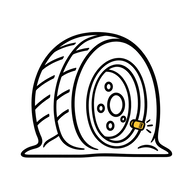 Flat tire
 What to do after a minor accident
 Light-duty towing
Highways that cut through the city
I-435 runs east and west through central Overland Park, I-35 skirts the northwest and north edge, and US-69 runs north and south. The first piece of I-435 opened in 1965 between I-35 and US-69, so parts of the road are older than they look. Interchanges include Roe Avenue (exit 77A, a diverging diamond), Nall, Metcalf, Antioch and Quivira. US-69 meets I-435 at exit 81, where the ramp to southbound US-69 also serves College Boulevard and 119th Street.
Diverging diamond ramps confuse drivers who limp off a highway with a failing car. If you coast down one, signal early and move to the right shoulder. Lacking a safe spot, stay on the road with hazards on and call 911. The full routine is in the highway breakdown guide.
A daytime city of 235,000
About 203,000 people live in Overland Park, but more people commute in than out, pushing the daytime population to roughly 235,000. That brings office park traffic along Metcalf and College Boulevard and a steady parade of delivery vans and rideshare cars. Stop and go driving and short trips are hard on batteries and brakes. If you notice a spongy pedal or a squeal, squeaking or grinding brakes explains what the noise means before you book a shop. A battery that cranks slowly is better caught with a replacement than a morning jump.
Weather in Johnson County
The area sits in a transition zone between humid subtropical and humid continental climates, with hot, humid summers and cold, dry winters. Average precipitation is near 40 inches. Ice on bridges and ramps is a bigger problem than deep snow, so keep your tires in good shape. Worn tread shows up first on wet pavement, and tire replacement is a cheaper fix than a ditch recovery. If your car slides off a driveway or shoulder, the guide to getting out of mud or snow explains what is safe to try.
Crossing the state line
The Kansas and Missouri line near State Line Road and Wornall Road splits one metro into two states. A tow ordered by a Missouri property owner follows Missouri rules, and one ordered in Kansas follows the Kansas statute that requires owner consent before a car is taken out of state. If you get a lost-car call from a company you did not hire, check the Kansas City, Missouri page too. Topeka's turnpike run is covered on the Topeka page.
When your car is towed
Kansas law lets a city write the rules for tows from private lots, including the price ceiling, and requires the tower to make a report to local law enforcement, within two hours, of where the vehicle is. Call the Overland Park police non-emergency line first, then the tow lot. Retrieval needs ID, registration and proof of insurance. To understand liens, read about the rules around tows from private lots, and ask for an itemized receipt before paying.
Why the arterials matter as much as the freeways
Much of the trouble in Overland Park happens off the interstate. Metcalf Avenue, Antioch Road and Quivira Road carry heavy traffic between shopping areas and office parks, with long signal cycles and turn lanes that leave little room to coast. Stalling in a left turn lane is dangerous. Put the car in neutral if you can, steer toward the nearest safe edge and keep the hazards on. Good lighting does not mean a safe spot to stand, so leave the car and wait behind a barrier or guardrail when one exists.
A stall that keeps repeating is worth a diagnosis rather than a push. A check engine light that appears together with hesitation points at ignition or fuel delivery, and a code reader costs little compared with an unplanned tow.
Everyday fixes near home
Many calls in a suburb are small. A lockout at a shopping center, a drained battery in a parking garage or a flat on 119th Street can be solved by a lockout technician or a jump from a roadside crew. Keep a gauge and know how to check tire pressure before you leave a cold garage, because the number on a dashboard warning can be wrong until the tires warm up.
Updated November 25, 2026




