


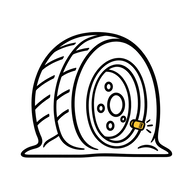
 Flat tire
 Car overheating
 Dead battery
 How to jump start a car
Where cars stall in Providence
I-95 cuts across the center of the city and, when it was built, it split Providence in two and cut the western neighborhoods off from downtown. Today the interchanges around downtown are close together, with ramps that merge within a few hundred feet of each other. A stalled car there blocks a lane quickly, so the first job is to get to the right edge, turn on the flashers and stay out of the travel lane.
Route 146 begins at I-95 northbound exit 38 and heads northwest on four lanes divided by a concrete barrier, with no shoulders at all. There is no direct entry from I-95 southbound, and the first two interchanges are partial, so a driver who guesses wrong ends up on surface streets. With nowhere to pull over, an overheating or flat-tire emergency on that road means rolling to the next exit if the car allows. Read about a flat on a tight freeway and a temperature gauge climbing in traffic before you need either.
Route 10, the Huntington Expressway, was the state's first freeway. It links Park Avenue on the Cranston line with I-95, US 6 and Memorial Boulevard, passing just east of Olneyville. Some of its junctions are incomplete, for example there is no ramp to Route 10 south from US 1 Elmwood Avenue, so exits can drop you onto city streets you did not plan to use.
The Washington Bridge and I-195
I-195 crosses the Seekonk River on the Washington Bridge between India Point in Providence and East Providence. The bridge has three parallel spans. In December 2023 the 1968 span closed abruptly for critical safety issues, and replacement is expected to reopen in November 2028. Until then westbound traffic shares the eastbound span, which squeezes the crossing and makes any stalled car there a long backup. Check the state's traveler information at dot.ri.gov/travel before heading to East Providence at rush hour.
Towing and parking rules inside the city
The Rhode Island state page explains the statewide notice clock for abandoned vehicles. The city adds its own rules. Providence runs an overnight parking permit system for street parking from 2 to 5 a.m. Permits cost $100 per year for cars registered in Providence and $200 for cars registered elsewhere. A household is limited to two permits and each vehicle must weigh 6,500 pounds or less. The city has discontinued its "do not tag" policy for cars on the street in those hours, and permit holders must give an email address because the city sends parking ban notices that way during snowstorms.
Tow companies working for the city apply through the police department's Traffic Bureau at 325 Washington Street, which accepts applications by email, mail or in person. If your car vanishes from a city street, the city's snow FAQ tells owners to contact the Providence Police Department's non-emergency line to learn where a towed car went, and the same call works outside a parking ban. A car taken from a private lot is a separate matter, and the guide to private property tows explains how those work. Unpaid tickets can also block a permit purchase.
Weather and what it does to cars
Providence sits on the line between humid continental and humid subtropical weather. January is the coldest month at about 29 degrees on average, and lows reach 10 degrees or colder on average 11 days each winter. Zero or below is uncommon and usually comes once every few years. Cold snaps still bring dead batteries and jump start calls, and weak cells fail first in a short-trip city where an engine rarely runs long enough to recharge.
July averages 73.5 degrees, with highs at 90 or above about 10 days per summer. Heat, stop-and-go traffic on I-95 and old streets are hard on cooling systems, so look at coolant level checks in spring. Winter nor'easters bring heavy rain or snow, and Providence's position at the head of Narragansett Bay makes it prone to storm surge. Hurricane Carol in 1954 and the 1938 hurricane both flooded the downtown. After any surge or flooded street, have a shop inspect the car before trusting it, since electrical faults can show up days later.
Driving patterns that shape calls
Providence is a college and hospital city of about 191,000 people, with roughly 1.7 million living in the wider metro. Street parking is tight in neighborhoods such as Fox Point, Federal Hill, the West End and Elmwood, so many cars sit outside for days and then fail to start. Commuters from Cranston, Pawtucket and Massachusetts feed I-95 and I-295 each morning. If your car stops in one of the tight neighborhoods, a jump start or lockout help often solves it at the curb.
Nearby cities
Warwick and T. F. Green Airport are about 12 miles south, covered in the Warwick guide. Worcester sits north along Route 146 and I-290, see the Worcester guide.
Updated November 25, 2026




